For those of us who thought the name Windows Phone 7 Series was too much of a mouthful, Microsoft has some deservedly good news: it will now be called Windows Phone 7. Period.No more WP7S, no more Series…just WP7, and Windows Phone 7…much to the happiness of journalists, developers and involved users everywhere. The happily truncated name was announced on Microsoft’s Windows Phone official Twitter account, with the chirpy words: “Tis the season for Series finales. We've got one too - dropping the ‘Series’ and keeping the 'Windows Phone 7.' Done.” Talk about droppings on Twitter!
This move will not entail any technical changes, but is simply a change in branding.
Tech Time (CST)
Welcome To My BLOG!.
Techzie brings you the Latest tech newz & gadgets around the world
sharing technology!.....among the WORLD
Tech Guru
santhu-o)))
Tech Tracker
Donate To My Blog by Just Watching These
Blog Archive
Blogroll
TechChat
Donate To My Blog
Live Stats!!..
Followers
Labels
- Apple (17)
- Apple iPhone (12)
- Apple iPod (1)
- Cell Phone (3)
- Dell (1)
- Droid (1)
- Facebook (3)
- GSM (1)
- GameBone (1)
- GeoHot (1)
- HP (1)
- HP Labs (1)
- Inspiron (1)
- Intel Atom (1)
- Internet (16)
- Linux (2)
- MSDN (1)
- Microsoft (9)
- Nokia (5)
- Operating System (3)
- Other OS (2)
- PS3 (1)
- RIM (2)
- Samsung (2)
- Sennheiser (2)
- Sony (2)
- Symbian (1)
- Twitter (1)
- android (4)
- att (1)
- blackberry (4)
- call interceptor (1)
- capacitors (1)
- carrier (4)
- cisco (1)
- crs-3 (1)
- google (10)
- htc (4)
- iPod (1)
- intel (1)
- ios (8)
- meego (3)
- memory resistors (1)
- memristors (1)
- mit (1)
- nanotechnology (1)
- network (2)
- osx (1)
- superconductor (1)
- tata (1)
- tweet (1)
- windows (5)
Follow me!..
All old enmities aside, Google has optimised many of its products for Apple’s latest game-changing device, the iPad.
The entire world seems to be cashing in on the iPad craze - with websites optimizing their pages, app developers creating specific new products or upgrading old iPhone ones, and video streaming sites resorting to HTML5 for iPad viewing - and Google is no exception.
The first of its products to be optimised is one of world’s favourite e-mail services, Gmail. While Google had already made a HTML5 iteration for Android and iPhone use, it has further customised the web app for the iPad by making it widescreen friendly, and providing the below pictured and quite handy 2-pane interface. It is to be used on iPad's native browser - Safari.
Other Google products optimised and available for the iPad include YouTube, StreetView, and GoogleMaps, apart from of course, GoogleSearch, which can be integrated directly onto the Safari browser (top-right corner). All these apps are available at Apple’s App Store, and many feature special gesture-based multi-touch controls. In related news, Yahoo has also launched a portal for the iPad, called Yahoo Entertainment.
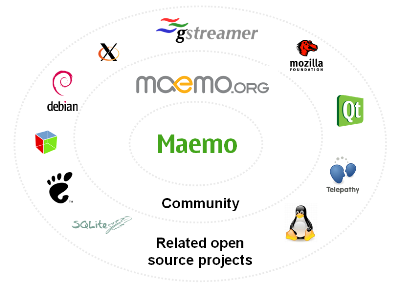
Amidst the flurry of new open-source phone operating systems, such as Samsung’s Bada, Symbian^3, and Android, Intel and Nokia have finally released a pre-release build of their MeeGo, yesterday. A Linux-based system, MeeGo is a developer-friendly combination of its parent’s previous operating systems, Moblin and Maemo, and will be released as a completely open-source operating system. The pre-release build MeeGo OS source code is currently only compatible with the Nokia N900, Intel’s Atom line of computers, and Atom-based mobile phones. It currently is geared towards back-end development, and developer tools, with no GUI or front-end interface as yet. The OS code can also be booted from a USB flash drive, apart from the device directly. Imad Sousou of MeeGo describes the build, "The MeeGo common core includes the various key subsystems including the core operating system libraries, the comms and telephony services, internet and social networking services, visual services, media services, data management, device services, and personal services." A full release of the OS code is due around May. 2010. Learn more and download the code at the MeeGo site.
Google is teaming up with Airtel to offer an ultra high-speed broadband Internet service in India. It looks like the 4Mbps connection for consumers and the 50Mbps broadband service for small businesses was just the tip of the iceberg, and Airtel has plans to cross a milestone in the Indian ISP business. If you recall, Google had already shared its plans to test an experimental gigabit network in the US. In this, India being behind the tech curve has proved to be of benefit, Google said, stating that India can leapfrog other countries which have to struggle with old lines and infrastructure. However, this won't be simple to implement and Google stated as much.
Airtel, meanwhile, has offered Google all the basic support, to reach out to the Indian metros, through their networks. Google thus needs to set up the TiSP Access Nodes and the central server, and Airtel will provide all the intermediate cabling and connectivity.
Airtel says, this service will be first available only in the major metropolitan cities of India; though no details on pricing has been announced.
Interested in using this 1Gbps line? Use this link to register yourself. The service will roll out on a first come, first serve basis, starting from next week.
In the past, interconnects of the modern chip fabrication process have always had problems with Joule heating and melting, as they traditionally have been built by metal, which conducts heat equally well as electricity. Interconnects on the nanoscale are called nanowires, whose electrical resistance unfortunately increases as they are made smaller. have a look!. However, using the new world’s smallest superconductor as the basis for a new-generation of nanowires might remove this problem altogether. Superconductors are so named because their electrical resistance tends towards zero, and will conduct electricity while only negligibly causing heat or power loss. The breakthrough comes with the fact that a certain superconductor is now known to be able to function on the molecular level, completely at odds with what scientists thought was a unshakeable truth, that superconductors only functioned on the macroscopic level. These findings will have tremendous applications in nanoscale electronics, most notably in microprocessor design and fabrication.Scientists at the University of Ohio have discovered what they claim to be the world’s smallest superconductor, which is less than 1nm in width. The superconductor works on a molecular scale and is formed by four pairs of molecules. The research was published in Nature’s Nanotechnology paper, and has been called a path-breaking idea in the field of nanoscale electronics.
A software update was released by Apple for the current Mac OS X line up yesterday. The update, which is meant for all users running the Snow Leopard (10.6.*) platform only, comes with a handful of patches, bug-fixes and solution for a few compatibility issues.
Users are suggested to back up their system, with Time Machine, as a usual word of caution. The update can be applied with the Software Updater over the Internet or the whole package can be downloaded and applied locally. The download size may vary depending on the system and the patches already applied before.Here we have a few notable fixes, it comes with -
- improve printing reliability
- reliability of photo screen savers.
- address a color issue in iMovie with HD content
- improve sleep and wake reliability when using Bonjour wake on demand
- resolve issues with recurring events in iCal when connected to an Exchange server
- improved reliability and compatibility of QuickTime X
- improve the reliability of 3rd party USB input devices
- compatibility with OpenGL-based applications
- background message colors to display correctly in Mail
- resolve an issue that prevented files from copying to Windows file servers
- improve performance of Logic Pro 9 and Main Stage 2 when running in 64-bit mode
- fix glowing, stuck, or dark pixels when viewing video from the iMac (Late 2009) built-in iSight camera
Apart from these, several other Airport (WiFi), MobileMe and Time Machine fixes have been introduced in this update.
Snow Leopard 10.6.2 users can update their system with this package [720MB]. To migrate directly from 10.6 or 10.6.1 to 10.6.3, this Combo Update [784MB] has to be applied on the system.
Oregon Scientific unveils solar-charged weather station (at approx. Rs. 2,477) and projection clock (price undercover)
Oregon Scientific is famours for unleashing a handful of new technologically distinct gadgets every year. True to their fame, a pair of new products have been released this year from their production stable. Although there is no scope to expect a completely new technological marvel, these products seem to catch the attention of the tech savvy, who have elusive and distinct tastes for tech-gadgets.Up first on the list, is the new ECO Solar Projection Clock that is equipped with a detachable solar panel and an integrated projector which beams the time image to be displayed onto a close-by wall. Second on the gadget geek's hit-list, is the neat and compactly designed Helios Weather Station that is armed with a built-in solar panel. The solar panel specializes in forecasting the weather conditions for the next 12 hours within the user's local area. It also has the ability to display indoor/outdoor temperatures and humidity for up to 3 locations around the user's present location. It is said that the solar projection clock will be available at an undisclosed price from April 2010. But, the Helios Weather Station is up for grabs now, at just $54.99, which roughly translates to Rs. 2,477.