TECHZIE.BLOGSPOT.COM

Your TECH GADGET GURU


Two months after the launch of Research In Motion’s PlayBook tablet, AT&T approved the BlackBerry Bridge app that pairs BlackBerry smartphones with the slate, just this afternoon. To add insult to injury, AT&T is requiring an extra $20 per month tethering fee (unless their data plan already includes the option) for PlayBook users to access the Internet through the Bridge Browser while the RIM devices are tethered, as noted in fine print on the Official BlackBerry Blog:
AT&T users must have a tethering plan included with their wireless service plan to take advantage of the Bridge Browser.
Matthew Miller over at our Smartphones and Cellphones blog wants to know what took AT&T so long? None of AT&T’s rivals Verizon, Sprint or T-Mobile had any trouble enabling the same app back in April, and neither T-Mobile nor Verizon charges for tethering. Irate netizens seem to believe AT&T just needed time to block the Bridge Browser from the non-paying tether users.
BlackBerry Bridge is crucial utility app that gives the PlayBook tablet access to the BlackBerry smartphone user’s existing secured BB emails, calender, contacts, tasks and BlackBerry Messenger (BBM), in addition to the Bridge Browser. Without the Bridge app, the PlayBook has no native BB email client and is one of the reasons the device was slammed by users and tech journalists at the time of launch.
According to RIM’s BlackBerry blog and from other PlayBook users, the Bridge app can work without cellular tethering for which AT&T wants to charge users. It sounds like it is possible to pair a BlackBerry phone with the PlayBook via Bluetooth or Wi-Fi to enjoy the Bridge app’s functionality without paying AT&T a dime. (PlayBook can also pair with a non-BlackBerry phone but just won’t have access to BB-only software and data.) But it’s unclear (at least to me) if the Bridge Browser would still be blocked when the phone is tethered to the tablet by Bluetooth or Wi-Fi, or must the phone have the tether option to unlock the Bridge Browser function? Personally, I would refrain from surfing the Web while the RIM devices are connected.
AT&T customers who needed the Bridge app earlier probably already found a workaround by now, if not they would have moved onto the next tablet already. I wonder how many AT&T customers returned the PlayBook after they realized they couldn’t use their phone and tablet as advertised before today.



Looks like the Infuse may soon get its screen size crown snatched. HTC Inside somehow got a hold of some images of what appears to be HTC’s next Windows 7 Phone megaphone — the appropriately-named Eternity.
The phone’s biggest pull so far is clearly its 4.7-inch screen, which tops even the 4.5-inch one on the Infuse. If the rumors are true, the Eternity will run on a 1.5GHz processor and come equipped with a 8-megapixel camera. On the device’s front is a 1.3-inch camera, the existence of which should give you something of an idea of when the Eternity will hit stores. Considering that support for front-facing cameras will come with Mango, it is safe to assume that the Eternity will arrive sometime this fall.
Another safe assumption is this: The Eternity’s battery life won’t be all that great. With a 4.7-inch screen and a 1650mAh battery, the Eternity’s title certainly won’t apply to how long the thing lives on a single charge. Then again, that shouldn’t come as much of a surprise anymore.


After 50 days of continuous assault on websites from corporations to government departments around the world, the six hackers known as LulzSec disbanded late last week but not without a parting gift.
Among the final release of leaked documents were ones from AT&T outlining its rollout of the LTE network as well as mention of the iPad 3 according to iFan.
iFan reports that in one document titled “2011 Weekly Calendar – LTE Milestones,” it said the “production launch will take place in July” and that ten more markets that were “promised LTE this year are on track to go live in September.” Verizon’s LTE network is already up and running so this information could very well be true.
Last week we told you that the next iPad is rumored to have an even higher resolution retina screen than the iPad 2, but if AT&T is rolling out a new network, the next iPad could very well be LTE-enabled according to iFan:
On a slide of a completely different PowerPoint presentation (pictured above), titled “LTE Status,” we see mentions of an iPad. This is where things get slightly more cryptic. Depending on how you interpret the message, it would seem as if AT&T is planning for an LTE iPad (probably the iPad 3, which is being rumored for a release either around March of next year, or this fall). Remember that this slide’s title is “LTE Status.” It wouldn’t make sense for a 3G iPad to be detailed on a page devoted to information on the 4Gstatus. With that in mind, this might confirm the rampant rumors of the iPad 3 being an LTE device. Given the timeline of the leaked information, it would also stand to reason that this new evidence points towards a March release, and not for the fall.
From what I can see in the leaked slide from AT&T, the carrier also makes mention of USB mobile broadband sticks and netbooks on the same “LTE Status” document so it seems the telecom will also be launching LTE-compatible devices to complement its handset offerings.
While we can’t confirm whether these leaked AT&T documents are up-to-date and contain reliable information considering that they were obtained illegally by hackers, the information contained in them certainly seem plausible.


Advanced Platform Designed to Deliver New Wave of Video, Mobile and Data Center/Cloud Services


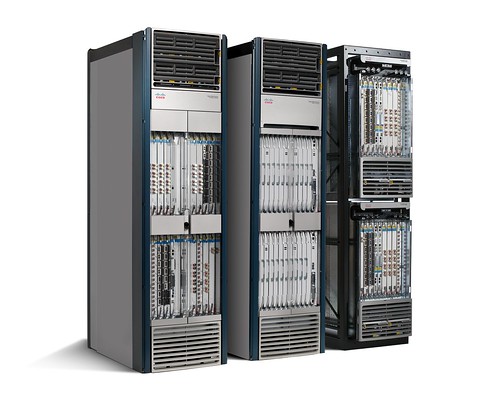
SAN JOSE, Calif., March 9, 2010 – Cisco today announced a major advancement in Internet networking - the Cisco® CRS-3 Carrier Routing System (CRS) - designed to serve as the foundation of the next-generation Internet and set the pace for the astonishing growth of video transmission, mobile devices and new online services through this decade and beyond.

With more than 12 times the traffic capacity of the nearest competing system, the Cisco CRS-3 is designed to transform the broadband communication and entertainment industry by accelerating the delivery of compelling new experiences for consumers, new revenue opportunities for service providers, and new ways to collaborate in the workplace.


Router Overview:


  • The Cisco CRS-3 triples the capacity of its predecessor, the Cisco CRS-1 Carrier Routing System, with up to 322 Terabits per second, which enables the entire printed collection of the Library of Congress to be downloaded in just over one second; every man, woman and child in China to make a video call, simultaneously; and every motion picture ever created to be streamed in less than four minutes.
  • The Cisco CRS-3 enables unified service delivery of Internet and cloud services with service intelligence spanning service provider Internet Protocol Next-Generation Networks (IP NGNs) and data center. The Cisco CRS-3 also provides unprecedented savings with investment protection for the nearly 5,000 Cisco CRS-1 deployed worldwide. Cisco's cumulative investment in the Cisco CRS family is $1.6 billion, further underscoring the company's commitment.
  • AT&T, one of the world's largest telecommunications companies, recently tested the Cisco CRS-3 in a successful completion of the world's first field trial of 100-Gigabit backbone network technology, which took place in AT&T's live network between New Orleans and Miami. The trial advances AT&T's development of the next generation of backbone network technology that will support the network requirements for the growing number of advanced services offered by AT&T to consumer and business customers, both fixed and mobile.
  • The Cisco CRS-3 is currently in field trials, and its pricing starts at $90,000 U.S.


Highlights and Capabilities for the Next-Generation Internet:

  • Unmatched Scale: With a proven multi-chassis architecture, the Cisco CRS-3 can deliver up to 322 tbps of capacity, more than tripling the 92 tbps capacity of the Cisco CRS-1 and representing more than 12 times the capacity of any other core router in the industry.
  • Unique Core and Data Center/Cloud Services Intelligence: In addition to capacity requirements, the growths of mobile and video applications are creating new multidirectional traffic patterns with the increasing emergence of the data center cloud. The new Cisco Data Center Services System provides tight linkages between the Cisco CRS-3, Cisco Nexus family and Cisco Unified Computing System (UCS) to enable unified service delivery of cloud services. This intelligence also includes carrier-grade IPv6 (CGv6) and core IP/MPLS technologies that permit new IP NGN architectural efficiencies required to keep pace with the rapidly growing cloud services market. Unique capabilities include:
    • Network Positioning System (NPS) -- provides Layers 3 to 7 application information for best path to content, improving consumer and business experiences while reducing costs.
    • Cloud virtual private network (VPN) for Infrastructure as a Service (IaaS)-enables 'pay-as-you-go' for compute, storage and network resources by automating Cisco CRS-3 and Cisco Nexus Inter-Data center connections for Cisco UCS.
  • Unprecedented Savings: The Cisco CRS-3 offers dramatic operational expense savings and up to 60 percent savings on power consumption compared to competitive platforms. The Cisco CRS-3 also delivers significant capital expenditures savings and investment protection for existing Cisco CRS-1 customers. The new capabilities in the platform can be achieved by reusing the existing chassis, route processors, fans and power systems with the addition of new line cards and fabric. These upgrades can be performed in-service and be provided by Cisco Services to ensure a smooth transition.
  • Silicon Innovation: The Cisco CRS-3 is powered by the new Cisco QuantumFlow Array Processor, which unifies the combined power of six chips to work as one, enabling unprecedented levels of service capabilities and processing power. Making this implementation even more unique is its ability to deliver capabilities with a fraction of the power required by lesser performing chipsets. The Cisco QuantumFlow Array chipset was designed to provide the new system the ability to scale with the ever increasing demands being placed on the IP NGN by the many different applications and billions of devices being used by both businesses and consumers in the Zettabyte era.


What ?.. People said!..

  • Keith Cambron, president and CEO, AT&T Labs
  • "We are entering the next stage of global communication and entertainment services and applications, which requires a new set of advanced Internet networking technologies. AT&T's network handled 40 percent more traffic in 2009 than it did in the previous year, and we continue to see this growth in 2010. Having leading edge experience in managing the largest global data network, we are pleased to continue our close working relationship with Cisco and its groundbreaking Cisco CRS-3 platform."

  • Pankaj Patel, senior vice president and general manager, Service Provider Business, Cisco
  • "The next generation Internet is upon us and we are confident that the Cisco CRS-3 will play a crucial role as service providers like AT&T deliver an exciting, new array of video, mobile, data center and cloud services. The Cisco CRS-3 is well positioned to carry on the tradition of the Cisco CRS-1, become the flagship router of the future and serves as the foundation for the world's most intelligent and advanced broadband networks."


Place an Ad